
Week 2 of the Program
Interns and students play a guessing game. 

Interns and students play a guessing game. 

The second week of the program brought a few surprises and many tears. I had two new Japanese high schools students, Shu and Souto. Shu came in with an amazing wealth of English vocabulary but no way to connect the words into sentences- even by the end of the first day, it was astounding to see how much progress he had made in terms of speaking and how much he had already grown to love asking questions. Souto was a bit shyer and very nervous about speaking at first, but as he warmed up to speaking with the other two interns and me, he quickly got more comfortable and loved sharing ideas and talking about his daily life. Together, I think the two of them encouraged each other as well.

We kept a running vocabulary list throughout the week, teaching the students words like “combine” or “residual” and having them repeat the words and use them in sentences during class when they wanted to explain something to us. I believe this really helped them not only with skills in explaining concepts in English, but also helped them practice sounding out unfamiliar words and encouraged them to continue growing their English vocabularies!

Throughout the week, we covered complicated topics like ideas for helping the Tokyo 2020 Olympics be a success and ways to help the world use more clean energy. Our group found simple ways for every Japanese person to save more energy, whether it was turning off the lights when not in the room or not using as much water when you shower. In addition, my students were fascinated by the idea of AI (Artificial Intelligence) being used in electric cars, and wanted to find a way to combine both ideas into one energy saving vehicle. 

We quickly found that giving presentations was going to be the biggest challenge for these two- both were incredibly nervous onstage and had not yet gained the confidence to speak English in front of a larger group of people. The first presentation was rocky; however, the next day, they worked even harder to ask us questions on how they could improve. After we watched (via youtube) Steve Jobs and Malala Yousafzai give speeches, our group reviewed how to give a great speech and hold the audience’s attention. For their final speeches on their life missions, Souto and Shu borrowed things like Steve Job’s confidence and Malala’s repetition of important phrases to enhance their own speeches.

I also gave a presentation in front of the class this week- on my major at University of Chicago and on how it connects to my life mission. I think my presentation went okay- I definitely need to find a better way to explain how economics and my other major, Law Letters and Society, work together to form my life mission, but I think the students had fun with the economics logic puzzle I introduced to them. I hoped that my being on stage would help my students become more excited about getting on the stage themselves.

The Life Mission speeches Friday afternoon were a stark and amazing contrast to my student’s behavior during presentations earlier in the week. They had transformed from shy and nervous to excited and eager to share their missions with the class. Shu volunteered to be one of the first students to present, bounded onto the stage to present, spoke clearly and thoughtfully, and as he sat back down in his seat, asked us if he could present to the class again! He wanted to create a nonprofit to help send wasted resources in countries like Japan and America to war-torn countries. Souto did his presentation on his life mission using math and science- to make a more practical and easy way for people to listen to music. His idea, using audio waves on different frequencies for different people, was something I could barely explain myself in English, yet he excitedly shared his ideas with the class, giving examples until all of the interns and students were nodding along with his enthusiasm. 
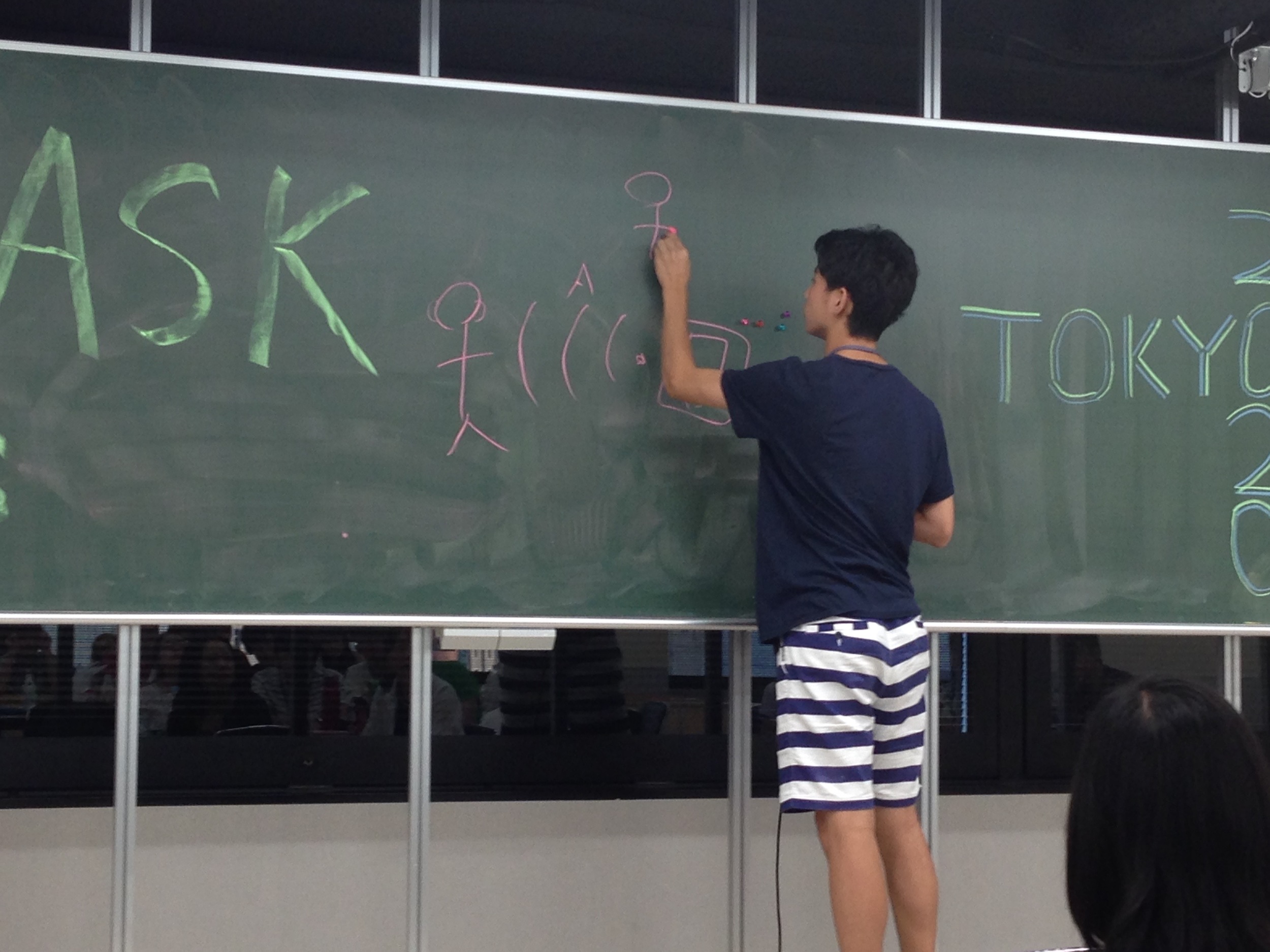
Drawing out an explanation. 

Drawing out an explanation. 

All in all, we were so incredibly proud of these two for not only conquering their stage fright, but improving so rapidly in English in under a week. These students have once again shown me that I need to be a better teacher in order to keep up with how fast they can learn. 

Week 1 of the Program: Part 2

Thursday and Friday classes showed just how much improvement our students had made over the course of only five days! Thursday was largely centered around on the UN Sustainable Development Goals, where our group chose to focus on how global education policy can be improved to provide access to education for all students. Kayato and Miyu suggested reforms from tons of research on education initiatives they had done the night before, and we interns kept them digging deeper into how the reforms they found could be applied to not only their lives but in places around the globe lacking strong educational systems.

Miyu had focused her research on the adoption of technology in classrooms, and suggested that schools in developing countries offer classes for parents as well, to start a conversation about what education can do for their children. Kayato thought that Japan should send more educational aid to developing countries, and decided that he would like to be part of his initiative and go abroad to teach. He had seen examples of organizations like UNESCO building private schools in Cambodia and Vietnam and the corresponding rise in income for people attending those schools, and talked to the group about those initiatives and how we can apply many of the same tactics around the globe. All in all, a fascinating discussion, not just because we could hear them talk so well in English about such important and difficult topics.

blog2016.jpg

We also focused a bit on correct speech format, and taught Miyu and Kayato the proper way to form an introduction, body, and conclusion of a speech. (Apparently, speeches or even talking in front of the class is incredibly rare in Japanese schools, so the practice here was much needed.) We prepared them for a speech on their UN Sustainable Development Goal (all of which went incredibly well), which also served as preparation for their big speech Friday on the Life Mission they think will suit their talents and interests. 

Friday afternoon, the students all came to the front of the classroom and presented their Life Missions. Before these speeches, I had of course seen the rapid improvement in my own students’ English skills and had noticed it in others, but I hadn’t realized the impact that a full week of speaking nothing but English could have on these students. Some sounded nearly fluent, and the ones that weren’t quite there yet had gained so much confidence in their speaking and were eager to keep learning.

Life Mission Presentations!

Life Mission Presentations!

Also fascinating and amazing was hearing the life missions themselves- the students were a diverse group and wanted to do everything from flight surgery (be a surgeon to astronauts) to work as a translator in Haneda Airport in Tokyo- but they all had one thing in common. Every single student wanted to have a job that connected them beyond Japan and to the international community. They wanted to continue learning English and go on to learn more languages, and they wanted to study abroad, go to college in the US, or spend time traveling and working abroad. Many of them hadn’t thought much about what they wanted to do specifically before this week, and the majority had no idea they would enjoy English so much or that they would want to have a more internationally focused career. Hearing the impact our talks about our American universities, our majors, and our hopeful future careers had on these kids really astounded me. Inever in a million years would have thought that I could have so much of an impact on formulating these kids’ lives, and I was so proud of the ways they have found to give their talents back to the world. 

Our closing ceremony with the kids was full of tears, from both interns and students. A few interns gave speeches in Japanese (with the funniest reactions from the students who hadn’t realized any of us could actually speak anything other than English), and we all took photos together and talked in small groups to say goodbye to the kids. 

I’m looking forward to my next round of students, and if they are anything like the past week’s bunch, there will be a lot of tears (again) at the closing ceremony Friday afternoon. 

Come On OutComment
Week 1 of the Program: Part 1

Halfway through our first week with our Japanese students, we already seem to be making some progress! My group consists of six interns and two incredibly bright Japanese high school students, named Miyu and Kayato. Both started out a bit quiet on Monday, but throughout the week have gotten more confident with asking questions and reading. 

To encourage the students towards a global mindset, we’ve been discussing culture, the American and Japanese educational systems, and ways that our students can apply the subjects they love in school now to college, study abroad, and future life goals. To engage the students with speaking and listening to English, we have played games like telephone and story-creating, talked about the 2020 Tokyo Olympics, and given presentations on college majors and career paths for certain academic interests.

For the Olympics (Tuesday afternoon), we spent time having the students think of ways they personally could assist in making the Games a success. Responses included teaching foreigners about Japanese culture and language, opening up their homes to visitors from all over the world, and encouraging the government to introduce a large-scale free wifi program around Tokyo. They gave their responses a ton of thought and didn't hesitate to ask our opinions as well! We finished the discussion by creating posters and having the Japanese students in each group present their ideas to the entire program- probably a stressful experience for all of them, but it made our students really put the English phrases they had been learning for the past few days to work. 

Japanese students present alongside their intern mentors. 

Japanese students present alongside their intern mentors. 

The intern presentations on the universities we attend and our majors have hopefully sparked some interest in the students. My group has a good mixture of economics, math, and Japanese majors, and we all have other interests that came out in our presentations! Kayato asked a lot of questions during intern Lynda’s math major presentation, and Miyu seemed eager to gather as much information as possible on American universities overall. She and Kayato were also both interested in the focus on sports in college- Miyu loves to dance, while Kayato plays basketball, and both were wondering how to continue those interests at an American university. We ended up speaking about not only our academic interests, but on how we and other American students enjoy our time outside the classroom as well. 

On Tuesday, my students began asking questions about life in America versus Japan, and we spent a while (very interestingly) discussing Kayato’s question about why he thinks Americans are more creative than Japanese. The interns and students alike got very into the discussion while we thought of possible reasons, eventually finding some aspects of Japanese culture are even more creative than in America! 

The interns in my group have also been doing daily vocabulary lists for our students- just to keep track of useful words they’ve had trouble with and can practice more. Every morning when the students come in, we’ve been starting off the session by reviewing hard words from the day before. We’ve taught them the definitions of cooperate, unjust, and nuanced, just to name a few. The interns will keep building on our list as the week goes on, and give the students the final list at the end of the week for them to keep practicing. 

So far, the English level these students not only come into the program with but also the speed at which they pick up speaking is amazing to me. I hope that every week starts out as smoothly as this one.