
The Global English Camp Program: an Experience of City, Country, and Community

From the bustling streets of Tokyo to the mountainous region of Hakone, I WAS ABLE TO EXPERIENCE the best of both worlds in two different prefectures during the Global English Camp program.

IMG_7943.jpg

Retreat Weekend

One of my favorite memories of Japan was our group retreat at Ashinoko Camp Miura in Hakone. We travelled from Tokyo by train, bus, and pirate ship.

unnamed.jpg

With cabins closely neighboring Lake Ashi, my surroundings were nothing short of idyllic. I bonded with many other interns as we roamed the grounds, battled the humidity, and barbequed the night away.

unnamed (1).jpg

Shines and Gates

I also visited the famous Hakone Shrine and red Torii Gate. Surrounded by a luscious forest, people from all over the world come to visit this famous landmark. If you come at the right time, you might witness a breathtaking view of Mount Fuji in the distance.

unnamed (3).jpg

While in Tokyo, I visited Harajuku, Shinjuku, and Shibuya, all of which had their own flair and gave me a taste of city life in Japan.

During my third week of teaching, I also stayed in Yokohama, a city approximately 45 minutes south of Tokyo. Here, I visited the Landmark Tower, shopping malls, the ramen museum, Chinatown, and had my first public bath. In all these cities, I shopped, karaoke’ed, and indulged in all the matcha treats and classic konbini food I could find.

unnamed (4).jpg

Food in Japan

Although my travels consisted of me getting lost at times, I experienced a sense of peace as I navigated the island. In relying on myself as a compass, I learned how capable and open I was to adapting to new environments. Every day was an adventure.

Food is also a big part of experiencing another culture. Thus, I made it my goal to eat as much as I could. From dining at ramen, udon, and sushi houses in Tokyo to trying new delicacies such as soba (chilled noodles paired with a dipping sauce), takoyaki (battered octopus balls), and traditional Japanese breakfast at my homestay, I was exposed to Japan’s rich gastronomy and unparalleled hospitality, or omotenashi.

Omotenashi

Japan identifies as a collectivist culture, meaning it believes in unity and being mindful of others as one goes about their daily life. Thus, many things are intuitively done in a ‘together-like’ fashion. I was a constant recipient of these gestures and deeply admired this philosophy. Being consciously aware of how our actions affect others requires us to be observant of our surroundings.

unnamed (7).jpg

Taking What I’ve Learned Back Home

After five weeks of what felt like a dream, my memories of Japan have led me to create a tamagoyaki (Japanese omelette) and rice dish topped with furikake (rice seasoning) at home. It was quite the attempt as I did not have the exact kitchenware and ingredients necessary.

I hope to get better in time!

Check out my vlog from this summer!

unnamed%2B%25288%2529.jpg

Thank you!

This past summer would not have the same without the welcoming spirit of Japan and my amazing peers and students. I’m so happy to have experienced the beauty and culture of this country and look forward to exploring more regions in the future.

Thank you, Global English Camp, for memories that will last a lifetime!

—

Written by Ellie Kapsalis, Global English Camp 2019 intern, UCLA 2019

Edited by Paige Goetz, Director of Communications
Come On OutComment
Teaching in Sapporo, Hokkaido

Week 2: Sapporo

The day I was assigned to teach in Sapporo, Hokkaido, I was super excited!

When I arrived in Sapporo during my second week of the program, my body immediately noted how not humid it was—unlike Tokyo. As soon as we exited the train station, a few staff were outside waiting for us. During our first hour, a few other interns and I were guided around the area by the staff. I swallowed up the sights that Sapporo offered: the scenery, the people, the calm aura. The city was smaller than Tokyo, but Sapporo evoked a more homey vibe. 

We were soon introduced to Odori Park. I can still remember the colors that mixed in the park; the different shades of green from tree leaves along with the plethora of pink, yellow, and white flowers sprouting from the ground. The flowers emboldened a pathway toward the famous TV Tower, which was a red-grayish metallic color. The tower stood tall and proudly displayed its bright digital clock. The sun was setting, a golden hue highlighting the serenity of the park. Not only was it the timing perfect, but also a chance to have a photo op. Our first introduction of Sapporo was a success. 

During our first night, a few interns and I tried out the best yakiniku place (like Korean barbecue). The restaurant was called Amatarou. There was the standard make-your-own-food dining area alongside a karaoke space! The food options were endless. Our bowl of “addictive” cabbage was gone within three minutes. The meal did put a dent on my wallet, but it was worth it! One thing visitors should try in Sapporo is the jingisukan, or Genghis Khan, which is lamb. It’s delectable. Aside from the deliciousness, my team members and I went to a place that not too expensive. There are many restaurants that serve jinjusikan around Sapporo, so visitors can easily find one. 

Our teaching venue in Sapporo was one of the best experiences of my life. The classroom was small compared to other venues I’d taught at; especially the venues in Tokyo. We were the only four interns, and each of us had five students to mentor. The small class size allowed me to truly get to know most of the students. And I was able to incorporate teaching my school chant. (I went to UCLA. ) During the breaks, we played games like charades and jan ken pon (the Japanese version of rock, paper, scissors).

On the last day, my team and I went to the Shiroi Koibito Factory, a chocolate factory! Fun fact: Hokkaido is known for dairy. The chocolates we tasted at the factory were freakishly creamy. After that, teaching staff took us to Mt. Moiwa, where we had the privilege to view the breathtaking view. of Sapporo After lunch, we went to the Hokkaido Museum, where we learned about the rich history of Hokkaido’s origin and the Ainu people.

Sapporo was and is a calm city. It was the perfect getaway from Tokyo. Sapporo rarely embodied that fast-paced, hustle and bustle vibe of Tokyo. The city was calmer, cooler, and a lot less busy. My time in Sapporo was one of the best weeks of the program.

Sapporo should definitely be in everyone’s bucket list when visiting Japan!

—

Written by Adrian Ruiz, Global English Camp 2019 intern

Edited by Paige Goetz, Director of Communications

Teaching in Mishima, Japan

Hello blog! For full transparency, this post was a private journal entry now turned into a public post. Welcome to a wild combination of secret information about our excursion as well as thoughts about my experience.

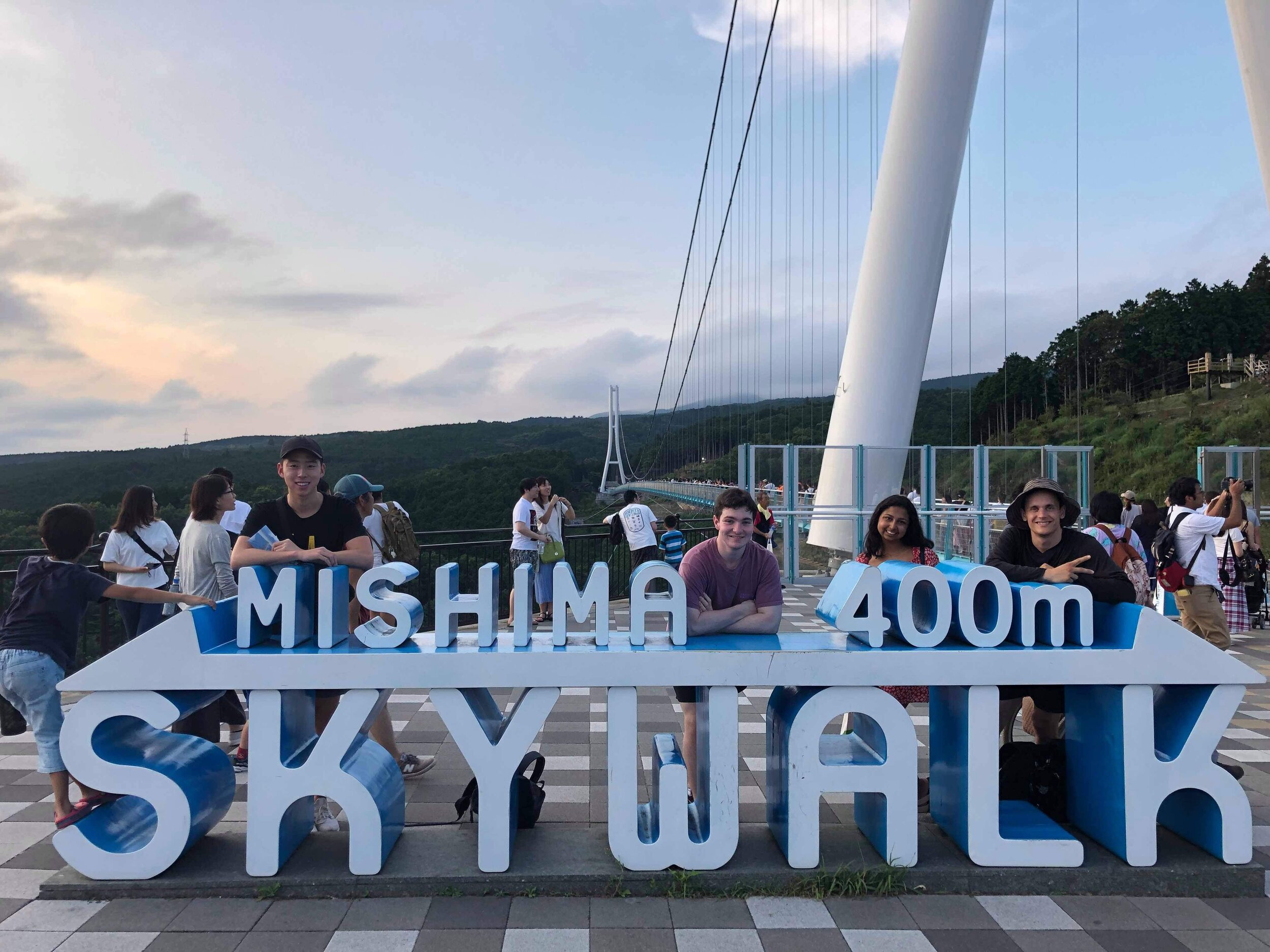
IMG_8854.JPG

After a fantastic week of teaching in Nagoya, our little group broke up and headed to the Shizuoka prefecture for Week 2 of English Camp. We were teaching in the city of Numazu, a quaint rural town nestled at the base of Fuji San (Mount Fujii.) The city has a beautiful stream, and our morning view is the massivem ountain itself. Children are always playing in the river, the cicadas are chirping. We were ready to begin our Week Two.

After having a wonderful week before, I was concerned that this week would have a lot to live up to. But it sure did. From meeting incredible kids, to having a good laugh with staff, we departed the venue on Friday with lots of heartfelt goodbyes, photos, and even a few tears.

Before we left, however, we asked the students what we should do with our next free day. One of Lawrence’s students, Hina, told him about a large suspension bridge, the “Skywalk,” in the neighboring town, Mishima. After hearing the bridge was the largest suspension bridge in Japan, had an amazing view of Mt. Fuji, and had a special fireworks show coming up, we were sold. The next day, we took a half hour bus ride from our home to Mishima Skywalk.

After stepping off the bus, we first hit the gift shop at the Skywalk gift shop. “Gift Shop” is too simple of a word to explain a beautiful, handcrafted array of food and goods complete with a flower archway. To make things even better, there was a stamp station outside the gift shop that my friend Mark geeked over. We wandered around the shop for a while and explored the various stalls. I ended up buying sea salt for my family. My friend Adam bought tea, and Mark bought a carved wooden egg. I also had my first mochi experience! Mishimi apparently has some infamous strawberry mochi. Verdict: unexpected texture, but solid for sure.

We left the gift shop with our various food and smiling eggs and went to get tickets for the fireworks show. On the way, I went to the bathroom. Normally, I would not blog about the bathroom. But this bathroom is worth blogging about. The Skywalk bathrooms, for some reason, is even suggested to visit in their travel guide. Everything about it screamed boujee from the massive throne-like arm chairs to the bamboo garden inside.

Then, I had my first a taste of yuzu, which tastes like lemon and orange had a baby. It’s now one of my favorite fruits. On the way to the fireworks, we stopped to see the city lights and Suruga Bay, Japan’s deepest bay. There was also a zipline, but we had come too late in the day to try it out.

We then went to an owl cafe where Mark was able to capture a video of the owl winking at him. We all lost our minds. The second shop, Tree Tree Tree, was all Skywalk themed. We learned many facts about the bridge, including that it’s Japan’s first ever privately constructed large-scale suspension bridge and that it was created so Mishima would be “a little more than just a checkpoint on the map.”

Before we walked back on the bridge for the firework show, we were all given orange glow sticks and were instructed to crack them at 8:15.

The show was incredible. Japanese fireworks hit differently. There were so many varieties and colors, like a neon blue shower, and one that had small circles. It’s impossible to explain, so please look at my pictures. With each firework, the four of us genuinely gasped in aw.

Watching fireworks off a beautiful suspension bridge in Japan is a moment I will never forget. I am so thankful for this program for not only allowing me to have this experience, but for also bring such amazing people together. I really miss my mates post Global English Camp.

—

Written by Marisa Sashti, Global English Camp 2019 intern, UCLA

Edited by Paige Goetz, Director of Communications

Come On Out Comments