Skateboarding in Japan: How to Meet Locals with Your Hobbies

Cultural differences and language barriers are challenges you may face while abroad. But there are ways in which you can expedite the integration. My suggestion? Identify something you love, like an art craft or recreational hobby, and use that as a tool to explore new areas and meet the locals.

For me, skateboarding was an active, creative outlet which allowed me to find a sense of community during my first trip to Japan.

Tokyo-2020-Skateboarding-Commission-Logo-FINAL.gif

In 2016, The ICC pronounced Tokyo as the inaugural host for skateboarding in the 2020 Olympic Games. This spike in cultural relevance deepened my appetite for discovery, especially considering that I live in Los Angeles, the birthplace of skateboarding. With all of this in consideration, I researched everything I needed to know about skating in Japan and made sure to pack my luggage with all the essential gear. After my arrival, I hit the streets, exploring Tokyo as an urban playground fit with some of the best spots and best people!

Top 3 Highlights

  • Making new friendships with the locals

  • Exploring various parts of the city I wouldn’t have otherwise

  • Developing my craft with a new global perspective and cultural influence

Things to Consider When Choosing your Tool for Exploration

  • How dangerous is it?

    • I fell pretty bad on my face during the last week of the program and spent a night in the hospital.

    • Pro Tip: Be familiar with your travel insurance!

  • What are the financial costs?

    • Skateboards seemed to be more expensive and of cheaper quality as compared to what we have in the US. Somehow, I broke three boards during my trip.

    • Pro Tip: Do your research and decide what is best to bring with you or to buy while aboard. You can save money in the long run.

  • Will it take up luggage space?

    • This wasn’t a big inconvenience, but all my gear (shoes, clothing, boards, etc.) took up prime luggage real estate.

    • Pro tip: Disassemble your equipment so you can organize it better and be more space efficient.

In short

  • Identify something you’re passionate about which could be explored while abroad.

  • Research the current trends and best places to explore.

  • Plan your trip and don’t forget to bring all the essential items to optimize your experience.

  • Explore to your heart’s content!

Sources

Written by Mark Biedlingmaier. Mark graduated from the University of California, Los Angeles in 2018 with a B.A. in Geography and Environmental Studies where he focused on the intersectionality of food, health, and sustainability. He currently works as a Project Coordinator for the Semel Healthy Campus Initiative Center at UCLA, an entity working to improve the health and well-being for students, staff, and faculty. This year he returns to Global English Camp as a Team Leader after having great experiences as an intern back in 2018.

Edited by Paige Goetz, Director of Communications

Come On OutComment
Staying Fit in Japan

How do I stay fit in Japan? What clothes should I pack to work out in Japan? Will I be able to find a gym?

For those in a rush, there is a TL;DR at the bottom of each section, as well as an FAQ at the bottom.

Screen Shot 2019-07-19 at 21.55.52.png

WHERE DO I TRAIN?

Finding an accessible gym in Japan is hard. Some gyms require a residence card or visa. Day passes can be over 30 USD. And you need gym-specific indoor shoes (or else rent some from the gym).

So how are you supposed to stay or get fit? Well, runners should have no problem adjusting to Japan. There are plenty of amazing trails. The information I’m about to speak of is more applicable to those who train for either functional fitness or hypertrophy (i.e. avid lifters, sports / calisthenics / parkour athletes)

The best place to train in Japan is without a doubt the parks. One of my favorite things to do when traveling to a new city in Japan is hike around to all of the parks and find the coolest places to train. Some parks will be very minimalistic with some parallel and pull up bars, while others will have elaborate structures with various platforms and obstacles that are great for freerunners.

If you have access to a few horizontal bars and the flat ground - you’ve got yourself a full calisthenics gym. Add in a resistance band and you can effectively target any muscle on your body.

TL;DR

Runners - just run outside. Everyone else - go to a park.

HOW DO I TRAIN?

How you train is based on your current fitness and future goals. For people only looking to maintain fitness level, I recommend paying more attention to your nutrition and sleep than your training (more info on nutrition below). Even if you go a full month without working out, you will lose practically no muscle mass or strength if you take in enough protein, hit your maintenance calories, and gain enough sleep.

As a rough estimate, muscle takes twice as long to atrophy as it does to build. If you don’t work out for a month, you should get back to normal in less than two weeks (again, assuming you are consistent with sleep, nutrition and training). However, you can prevent muscle loss by exercising 1-3 days per week.

I would generally recommend the following splits:

  • 1 Day (per week): Full Body HIIT Workout

  • 2 Days: Upper Body / Lower Body

  • 3 Days: Push / Pull / Legs

If you want to take it a step further and improve your fitness, you must do one or more of the following:

  • Increase training specificity

  • Increase training intensity

  • Increase training volume

(None of these can be done well without proper diet and recovery.)

As for the specific workouts, check out the Bodyweight Fitness subreddit’s recommended routine. They also have an amazing page on exercise progressions ranging from never-worked-out-before beginner movements to borderline humanly impossible ones.

 If you’re worried that calisthenics will make you “lose your gains” - don’t be. If anything, calisthenics will help you identify muscle imbalances, improve joint health, posture, core strength, stability, mobility and flexibility.

 TL;DR

You’ll be fine for a month or so if you don’t work out, as long as you eat and sleep well. If you wish to improve during your time in Japan, or if you’re paranoid about “losing gains”, look at calisthenics / bodyweight and resistance band workouts and train as much as you want to.  

Finally, NUTRITION.

Chances are, you’ll eat a lot of konbini food while in Japan. Almost all of the konbini will have chicken breasts, salads, vegetable cups, fruit, hard boiled eggs, and brown rice onigiri. Of course, there are other less healthy but still decent options, too - sushi, bento boxes, and sandwiches. Obviously, keep the junk to a minimum whenever possible.

That being said, also try as many unfamiliar snacks, foods and drinks as possible. Don’t deny yourself amazing experiences!

TL;DR: Eat healthy-ish food.

Screen Shot 2019-07-19 at 21.55.57.png
Screen Shot 2019-07-19 at 21.55.26.png

FAQ

 WILL JAPAN MAKE ME GAIN FAT / LOSE MUSCLE?

That’s your choice; not Japan’s. Either way, it won’t be significant in the long run. 

CAN I FIND PROTEIN / SUPPLEMENTS IN JAPAN?

Yes. Don Quixote, Yodobashi, Bic and Costco will all probably have some whey in the health sections. I have seen protein drinks in pharmacys and konbini as well. Anything you can’t find in a store can be bought online.

WHAT IF I REALLY WANT A GYM?

Google English friendly gyms in your city (unless you speak Japanese), get gym shoes, and bring lots of money.  

WHAT IF I WANT TO DO SPORT / ACTIVITY XYZ?

If you’re going to a big city like Tokyo, they have it. Skateparks, parkour meetups, gymnastics gyms, dance studios, yoga, running clubs, swimming pools… they have everything. If you can’t find it by searching in English, ask a Japanese speaker for help. The search results are better in Japanese.

 WILL I LOOK WEIRD IF I WEAR ~~~?

If you have to ask, then the answer is probably yes. While it isn’t as common for Japanese people to wear tank tops or shorter shorts, it isn’t illegal. Try to be modest when working out, but it's also extremely hot, so be prepared to sweat.  

HOW DO I READ NUTRITION LABELS IF I DON’T SPEAK JAPANESE?

Check out this article.

WHAT SHOULD I PACK TO WORK OUT?

Workout shoes, clothes, and a resistance band if you’re into that. Once you get here, I would also suggest picking up a small sweat towel and water bottle at a 100 yen shop. Japan is hot. Going to a vending machine every time you work out adds up if you work out a lot.

SHOULD I AVOID TRAINING WHEN I’M JET LAGGED?

No, training helps with jet lag, and the effects can be significantly reduced.

More info here

Written by Dalton Brown, Global English Camp 2019 Leader, University of Michigan

Edited by Paige Goetz, Director of Communications

Come On OutComment
Where to Hike in Tokyo
 

For hardcore outdoors enthusiasts, the 7+ hour overnight climb of Mount Fuji may be a dream come true. If you prefer a more leisurely experience with nature, Mount Takao might be the right fit for you. It certainly was for me.

Mount Takao is a popular sightseeing destination with a plethora of fun activities beyond those you might expect on a mountain.

The area is easily accessible from Tokyo, with a direct train from Shinjuku Station on the Keio Line taking about 50 minutes and costing ¥390—perfect for a daytrip. The train takes you to Takaosanguchi station (高尾山口駅), a few minutes’ walk from the foot of the mountain.

kotsuzake

kotsuzake

As for hiking the mountain, several options are available. There are six numbered trails up the mountain.

#1 takes about 90 minutes to traverse and is the most popular and easiest technically, being fully paved, and has the best access to the mountain’s non-hiking attractions. #2-#6 are unpaved and offer varying levels of steepness and difficulty.

Expect to meet many fellow hikers!

tako-sugi

tako-sugi

The “Beer Mount” is an all you can eat and all you can drink outdoor restaurant that runs during the summer months. It serves mostly Japanese cuisine from a buffet—dumplings, oden, and a variety of beers, sake, and teas and other soft drinks. Though very busy on the weekends and evenings, we had little trouble finding seats on a weekday afternoon. While a bit of a splurge (at ¥3800 for men and ¥3300 for women for two hours), I found both food and drink to be great and especially delicious after working up an appetite from hiking. After eating, we sauntered the rest of the way down trail #1 and took the train back to Shinjuku.

5_bridge.jpg
4_summit.jpg

A multitude of shops and restaurants line the road from the station to the trailheads, and it was here that my hiking buddy and I made our first stop for a treat: kotsuzake[1] (骨酒, literally “bone sake”), a uniquely Japanese beverage consisting of hot sake steeped with a whole grilled fish.

To my surprise, I enjoyed this despite my initial hesitance. The fish lended a wonderful roasty, salted, and mildly but not overbearingly fishy flavor to the sake, while the fish (eaten afterward) was infused with the sake’s sweetness, not unlike a marinade.

I would wholeheartedly recommend it!

2_octotree.jpg

For maximum relaxation, both a chair lift or cable car can take you about halfway up the mountain. My friend and I opted for the chair lift, which offered excellent sightseeing on the way up, followed by trail #1 to the summit.

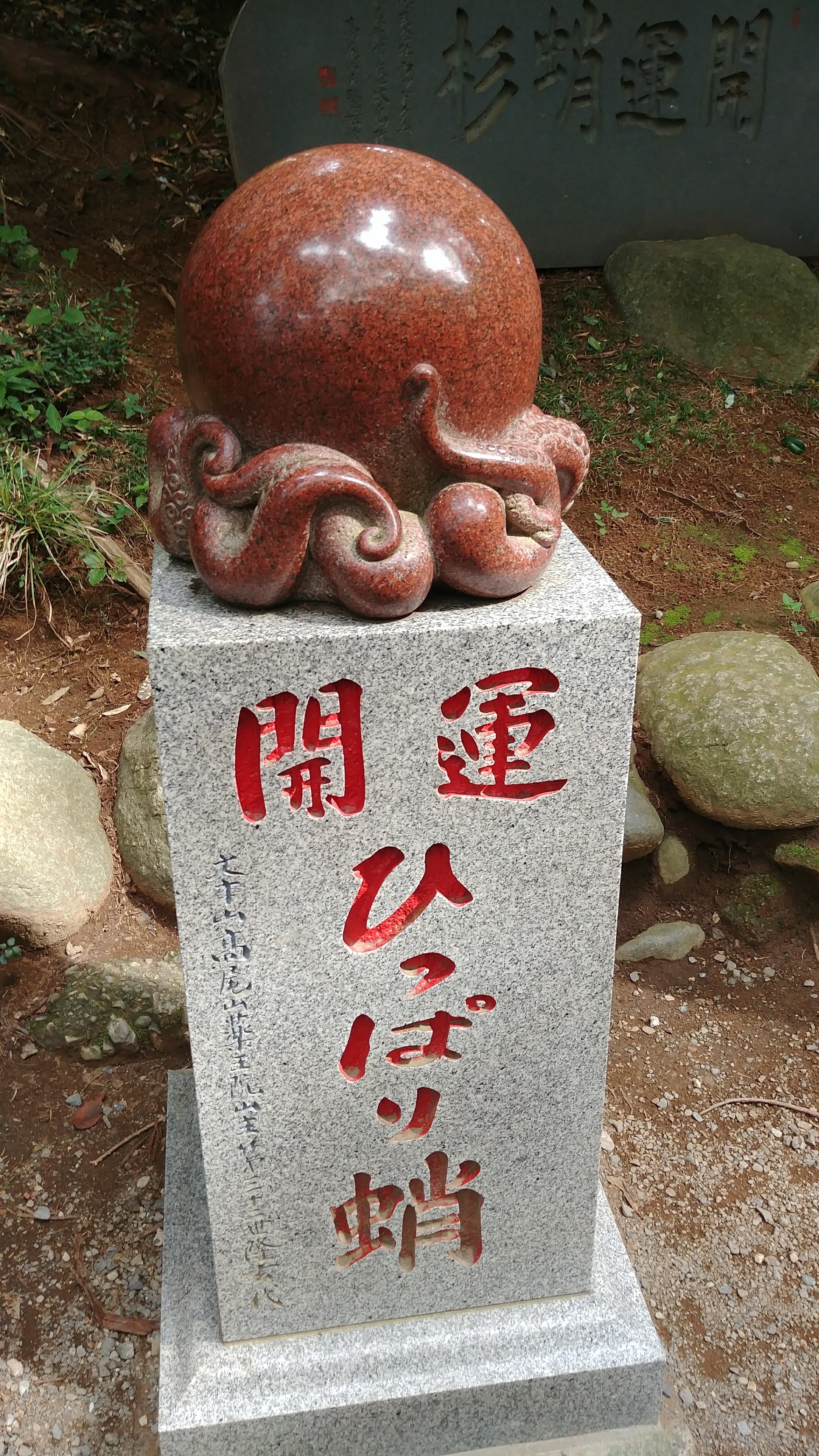
Along the trail we stopped at “tako-sugi,” a cedar tree with octopus-like roots commemorated by a very cute statue. We also saw Yakuoin Temple, a buddhist temple with beautiful architecture and more statues. Once you reach it, the summit offers wonderful views of Tokyo and, if you’re lucky with weather, Mount Fuji.

Descending the mountain, we opted for trail #4, which was only slightly more difficult than the paved trail but brought us deeper into the forest and over a highly photogenic wooden suspension bridge. This trail rejoined trail #1 at the halfway point, near the chairlift and cable car stations as well as our final stop for the day: the Takao “Beer Mount.”

6_beermount.jpg

With all the trail options and supplementary activities (including many I didn’t mention here), Mount Takao a trip easily tailored to individual tastes whether you’re a nature aficionado, relaxed foodie and sightseer, or anywhere in between. I hope you make a trip!

[1] Sometimes iwanazake (iwana being a type of fish) or iwana no kotsuzake


Written by Colin MacGinnitie, Global English Camp 2019 Leader, University of Chicago

Edited by Paige Goetz, Director of Communications

Come On OutComment