Japan for First-Timers: 5 Quick Tips!

When I was accepted into the Come On Out - Japan program in 2018, you best believe that I spent hours and hours reading random forum threads and watching YouTube videos to prepare for my first trip to Japan. Having now traveled to Japan twice, once to teach (2018) and once on a solo-trip traversing across eight cities from Tokyo to Fukuoka (2019), I have reflected on the many, many logistical snafus I’ve made and experienced. Here are the top five things I recommend (and will be) doing, in order of importance, either before or as soon as you arrive in Japan to make your life (and COO experience) easier!

1. Download Japanese on Google Translate AND Google Maps.

BONUS: Learn the following:

·       sumimasen – excuse me/sorry/thank you (use when you bump into someone, when you want to stop someone to ask for directions or help, or when you need to get the waiter’s attention)

·       arigato gozaimasu – thank you

2. Get a SIM Card or PocketWifi.

There are many rental services you can find online to do so (prepaid SIM, rental SIM, rental PocketWifi, etc etc). As always, please do your research before you make a decision! I personally use CdJapan (https://rental.cdjapan.co.jp/) to rent an unlimited data SIM card. I have an iPhone and usually rent the cheapest data SIM they offer (200 MB high speed per day, unlimited 256Kbps afterwards (super slow data), for 40 days = ~53USD) and it is more than enough for ALL of my google maps, internet search, and Messenger/ WhatsApp/ LINE needs. (Disclaimer: I preferred this option because I don’t use much social media and didn’t want to carry around a PocketWifi everywhere). If you’re someone who often checks their social media apps and streams videos on data, I would recommend getting the PocketWifi instead. While there’s free wifi at train stations and convenience stores, I found that being able to communicate and navigate from any location was way more convenient and gave me a sense of independence and safety. (Note: if you decide to pick up your rental from the post office at your arrival airport, make sure you are arriving WITHIN the post office operating hours).

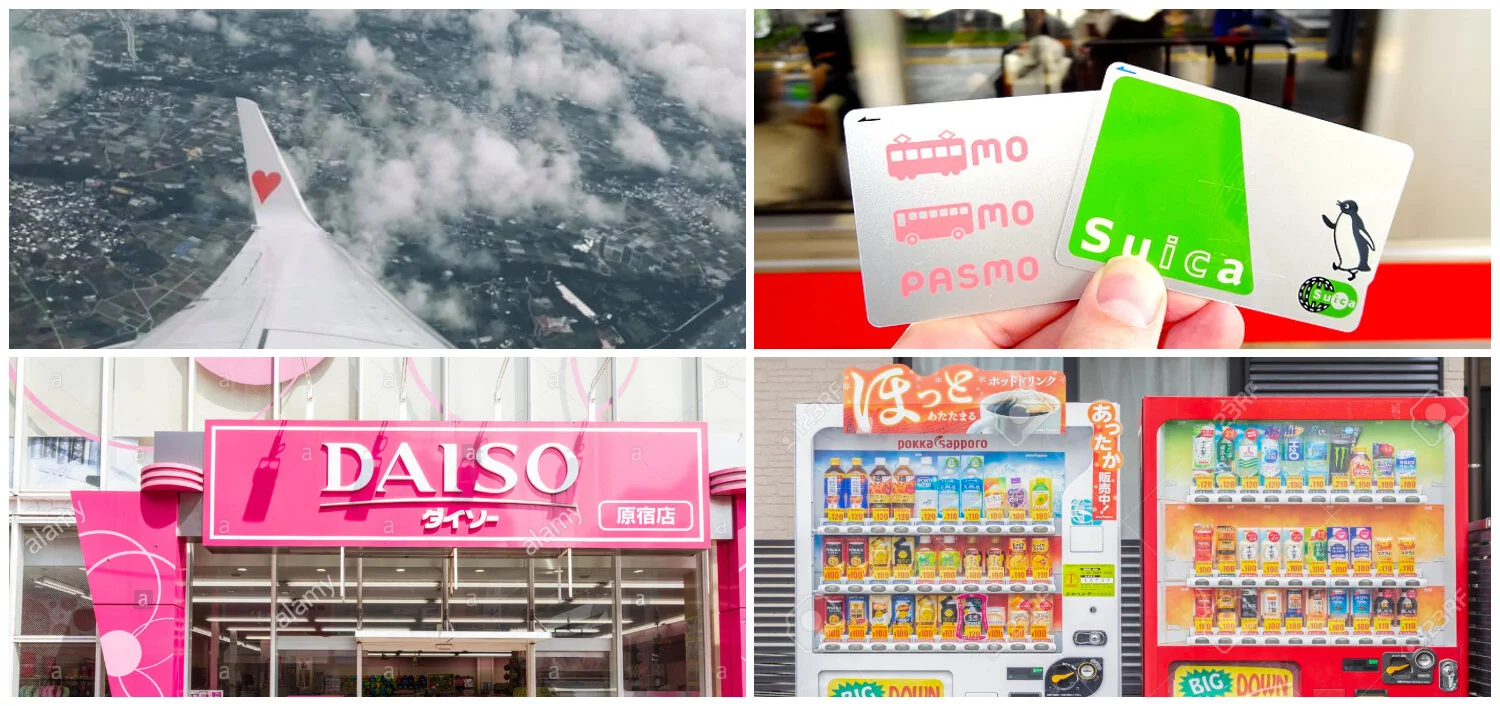
3. Buy a Pasmo or Suica card. Doesn’t matter which one, depends if you like pink or penguin. When you arrive at your airport, navigate your way to the public transportation area and get yourself an IC card ASAP. MAKE SURE YOU HAVE CASH. While credit cards are great, Japan is definitely a cash society and these machines only accept cash. I recommend putting in 5000 JPY (~50 USD) to start off. These cards are used on all public transportation and can be used to pay at any convenience store (just say “Pasmo” or “Suica” when you pay) and even at some vending machines. You can reload them later on as needed.

4. Bring an electrical adapter and portable charger. While your iPhone chargers will work just fine here, you definitely need an adapter if your laptop charger is three-pronged or otherwise. You will also always either be lost or looking for a place to eat, so your phone will run out of battery quickly. Also I apologize for the focus on iPhones, but that is the only experience I can speak to (sorry Android and other users)!

5. Go to a 100Y shop within the first week. The dollar stores in Japan are a dream (not to be confused with convenience stores like 7/11, FamilyMart, and Lawson). Stop by here for basic necessities that you perhaps forgot to bring (towel, toothbrush, wet wipes) or things you may later need for teaching (whiteboard, stationary, snacks). My top recommendations are Daiso or Can Do. Prices here are much lower if you don’t care about name brand things. If you’re pickier about skincare/soaps/makeup brands, I would recommend going to variety stores like Don Quijote or Bic Camera.

All in all, Japan (esp. major cities like Tokyo and Osaka) are traveler friendly, so don’t stress too much. But most importantly, make sure to come to Japan with an open mind and an open heart, and I promise you’ll have a wonderful time. Good luck!

—

By Angela Lin, 2018 and 2020 Global English Camp intern

Come On OutComment
Things Youtube DIDN'T Tell Me about Japan

Before I did the 2016 Global English Camp program, I felt decently prepared for Japan. I watched all the JVloggers on Youtube, studied Japanese language for five semesters, and taught English to Japanese study abroad students for two years. When I arrived to Japan, most of Global English Camp’s training week segment on cultural norms felt more like a refresher — don’t walk and eat in public, don’t talk on the trains, don’t stick your chopsticks upright into rice—the usual. But now that I’ve been to Japan six times, I’ve noticed a few things that I’ve never read anywhere else.

some small things that aren’t covered during global english camp’s training week:

  • The only peanut butter you can typically buy in Japanese grocery stores is Skippy brand. For some reason.

  • Grocery stores usually have cheaper food prices compared to conbinis like 7 Eleven and Family Mart.

  • Tech accessories in conbinis, I’ve found, are especially overpriced. My iPhone headphone adaptor that I pay $8 for in America was $25 at a conbini, and my iPhone charger was $30. Buy tech at Donkihote instead.

  • Book Off, a used book and tech store, is a great place to buy new video games for a cheaper price. If you’re buying games for a console that isn’t region locked, then you can buy them in Japan without any problems. I got Fire Emblem: Three Houses for thirty bucks, and my friend got Legend of Zelda: Breath of the Wild for forty.

  • Often times, people wait for red walking signals to change green even if no cars are coming. If you walk through the red signal when the coast is clear, people may stare at you strangely.

  • Although trains in Japan are quite easy to navigate once you understand the system, there are a few quirks foreigners still tend to screw up because of the language barrier. Sometimes, multiple trains, all going in the same direction on the same platform, will have different stops along the way. These trains may be separately marked as local, rapid, special rapid, or commuter rapid. Usually, different trains are marked with different colors. In the case of my platform, my slowest local train was yellow, my rapid train was orange, and my commuter rapid only accessible during rush hour was purple. Use Google Maps to double check if you’re stepping on the correct one.

  • The bottoms of your feet may get ugly. In Japan, you walk everywhere. No matter how great your shoes are, you’ll build up some wild callouses and tough heels. After dealing with foot pain in Japan for a long time, I finally found two pairs of Doc Martens that no longer destroy me. It’s also a smart idea to own at least two pairs of shoes so that you can trade them on and off. This helps your feet become less damaged over time.

These are some small things I’ve noticed, though I’m sure there’s plenty more. Someday, I may do a round two.

Good luck out there!

Paige

—

Written by Paige Goetz, Director of Communications

Come On OutComment
Must-See Historical Sites in Japan

Japan is famous for amazing heritage sites located throughout the country. I had the fortune of touring the Kanto region, specifically Tokyo and Yokohama, to view some of these peaceful locations.

In the Asakusa district, there is the Kaminarimon Gate (雷門) with two large statues of Buddhist deities. Their names are Fujin and Raijin. Through the gates, there is a shopping street, Nakamise-dori, that leads to a Buddhist temple called Sensoji Temple (浅草寺). Without going into too much historical detail, Sensoji Temple is considered Tokyo’s oldest: 645 AD. I travelled with a few local friends who told me that when you pray, you don’t need to clap your hands since it is a Buddhist temple. The shrine has a beautiful garden and a five-story pagoda.

unnamed-5.jpg
unnamed-4.jpg

During 730 AD, in Otemachi, Tokyo, the Kanda Myojin Shrine (神田明神) was built. The temple was moved in 1603 to its current location, close to Akihabara, and now sells talismans blessing electronics and technology. This shrine also hosts the Kanda Matsuri, one of the biggest festivals in Japan, every year. My friends and I enjoyed the peaceful atmosphere as we sat in the courtyard to take a break.

unnamed-3.jpg

In between Shinjuku and Shibuya on the Yamanote Line is Harajuku Station. Located nearby is a forest in the middle of the city. Here you find Meiji Shrine (明治神宮) and Yoyogi Park (代々木公園). The torii gate is the entrance to the shrine grounds, and the tranquil forest surrounds everything from all sides, completely blocking out noise of the city. I found myself buying a couple charms as part of the Shinto shrine tradition reading: good health and good fortune. My friends and I sat at a bench to enjoy the view and drink water—the summer heat was strong that day.

unnamed-6.jpg

The last temple I visited in Tokyo was Zojoji Temple (三縁山増上寺), right beside Tokyo Tower and encompassed by Shiba Park. This temple is a major tourist destination due to its proximity to Tokyo Tower. It is relatively close to Hamamatsucho Station and is another Buddhist Temple.

unnamed-2.jpg

Of course, there are other small shrines and temples located throughout Tōkyō, but unfortunately I didn’t have time to visit them all. My next stop was Yokohama—the first harbour city originally used as the entrance to Japan by the rest of the world long ago. From there I travelled to the small but festive town of Kamakura to see the great Buddha statue, or Daibutsu (大仏). Although Daibutsu is not a Shrine or temple, it is still an important historical site and national treasure of Japan. The colossal bronze statue is a model of Amida-butsu, also known as the Amitābha Buddha. It is said to be almost 800 years old from temple records.

unnamed-7.jpg

Not too far from the Daibutsu is Hokokuji Temple (報国寺). As I walked the pathway to this shrine, the scenery changed, and walls of bamboo soared up to the sky. The secluded atmosphere makes this shrine a wonderful place to relax and contemplate. I pulled out an old book to sketch some of the elegant scenery. Supposedly, there are over 2000 bamboo stalks that make up the forest.

unnamed-1.jpg

The last place I visited was Tsurugaoka Hachimangu (鶴岡八幡宮) in Kamakura. Its origins stem from the Kamakura government and the samurai god, Hachiman. Upon entering the torii gate, a long pathway leads to a shrine maiden dancing stage. I actually visited this shrine a few times because of its unique beauty. However, be warned that it is always busy during the day. I recommend visiting in the late afternoon or early evening.

unnamed.jpg

Written by Gillian Dickie, 2019 Global English Camp intern

Edited by Paige Goetz, Director of Communications

Come On OutComment