The Spirit of Japan: Why This Culture Will Stay With You
Five weeks on, I feel the same nostalgia as when I landed back in the UK. It is a nostalgia that I can’t seem to shake. The culture of Japan has grown into something that I greatly admire, and wish to once again be a part of, based on the way that I experienced it this summer. Having spent my early days in the country in a tourist mindset, I asked my students; “What is one thing that you think foreigners should know about Japan?”. The answers I received ranged from spirituality to clothes and dessert treats. Yet, what they told me did not accurately describe the way that I experienced it. Instead, I saw for myself the features that make up Japan’s culture – from music to food, traditions, language, and in daily life. There are so many parts of this culture that it cannot be described within the single sentence answers they gave me, but must be experienced first-hand.
Prior to my own arrival, I frequently saw travel videos and praise for Japan, which is becoming increasingly prevalent in the media, but I wondered; “Will it stay with me as much as they say?”. Short answer, yes. Living in a place is the only way to gain these perspectives, and I felt that throughout my time in Tokyo, for myriad reasons.
One of the first answers I got from my students was that animation (i.e., anime and manga) was an intrinsic part of Japanese culture. Across Tokyo this is undoubtedly true, as there is animated art on the walls in most neighbourhoods, and anime-related shops on every corner. However, he also described how essential the animation industry itself was, providing numerous jobs to people across the country. So, as I saw this art on the walls, the tucked away Pokémon card vending machines, and manga in every bookstore I thought for the first time about all the industry itself.
Following this, our discussion then quickly went on to food – having this conversation right before lunch, I was not remotely surprised. That said, they highlighted to me another key part of their culture. Something that I had looked forward to on my trip was the chance to try authentic Japanese food – ramen, udon, and ramune soda – so I thought, to some extent, I knew the importance of this, but I was sorely mistaken. What comes immediately to mind is the use of chopsticks. I had viewed chopsticks as what to use when eating a meal, yet I was given strange looks by my students when spotted eating crisps with my hands. They asked, “Why do you want to get your hands dirty when you don’t have to?”, and it dawned on me that this had never really occurred to me; it was just something that I did. To them, this was bizarre.
From there, they moved on to their favourite foods and things that I should try. There were the obvious things, like I mentioned, and yet they also put an unexpected emphasis on konbini snacks. When we arrived on the programme, our bosses introduced themselves with their home country, university, and favourite konbini snack, taking me a bit by surprise. I expected it to be the same as a British/American convenience store, where the food is nothing special, however, this couldn’t be further from the truth. We went to Family Mart for lunch daily for food that beats most Japanese food I have ever tried in the UK. Similarly, as I explored the city, I’d stop for a 7/11 smoothie whenever the opportunity presented itself. Not to mention the konbini snacks that our bosses had mentioned; these were discussed at length between my students and I, resulting in me bringing a whole bag back to the UK at the end of my trip. While I had anticipated the quality of my meals in Japan, it was the little things that amazed me, and it is the little things that I miss.
Nonetheless, something that came up time and time again was matcha and tea ceremonies. Many people I’d spoken to had said they wanted to try one, while I was yet to understand the significance of it. In the UK and the US, matcha is all over social media, and, in many cities, matcha-themed shops keep popping up. I must confess that I’m not the biggest fan of matcha – a controversial statement amongst my students – so I did not fully understand the fanfare around it. Still, my friend and I tried a tea ceremony at the end of the trip. While in the UK, matcha is presented, in a way, as a trend, this ceremony gave real meaning to it. In such a peaceful environment, putting the ingredients together in a specific order, with traditions on how to sit and how to drink, it was easier to grasp this as a tradition, more than just another trend. I admit that this didn’t turn me into a matcha fan, and yet I do now think of this ceremony and these traditions while being back home and seeing these shops. This memory stays with me, and gives the food culture much more meaning.
Later on in the day, after lunch and our discussions about food, I would ask my students what music they wanted to play as we worked. After a somewhat unanticipated list of English/American recommendations, we got on to the subject of music, dance, and Japanese idols. They listed names that everyone in the classroom recognised and praised, as iconic and karaoke classics. This was not overly shocking to me at this point, since everywhere we looked – like with animation – there were idols on TV screens, advertising their latest albums. To them, karaoke with these songs was essential, in this same way that karaoke became essential for us, as one of the main bonding experiences for the programme. I never thought of doing karaoke as much as we did, with it becoming the obvious choice if we found ourselves without anything to do. Part of our team bonding was intwined with karaoke, so much so that we burst into song randomly in the street, in the classroom, or at home. It became part of our own routines as well, as we joined the community of Japanese people who go to karaoke after-work, performing our own iconic songs and classics.
Outside of this, one day the students performed a talent show. My students showed me the Soran Bushi dance – a traditional dance mirroring fisherman, symbolizing community and resilience. Having taught it to me (and insisting I perform it with them), I felt the cultural exchange that I had travelled to the country to experience. Much to my delight, it was recorded, and it my favourite video to watch back. This is something that has stayed with me in the months that I’ve been home, and every time someone asks, “What was the best part of the trip?”, the Soran Bushi is my immediate reply. The cultural exchange of Japan is what plays on repeat in people’s minds – whether it be watching or taking part, as the traditions have us branching out from what we know back home. Learning a dance with history and significance, which everyone within a community knows, provides a stark conflict to the idea of a meaningless TikTok dance that I am used to.
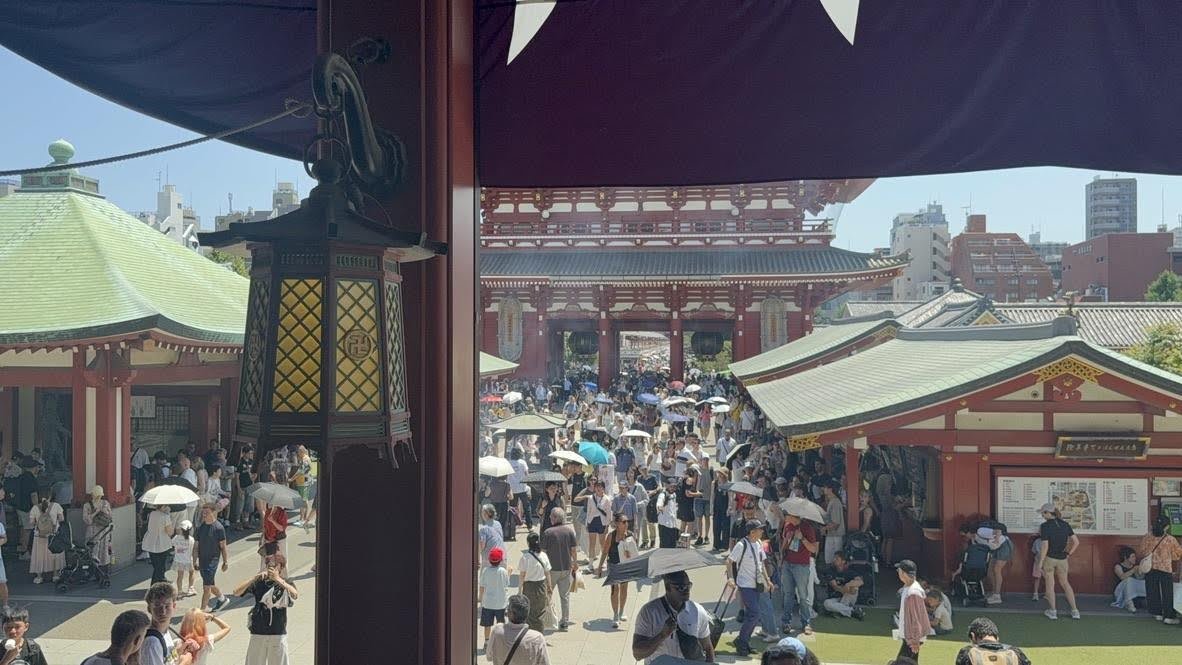
These traditions extend beyond activities that everyone knows into events that everyone attends. Despite not attending the events my students mentioned (i.e., summer festivals, or school sports festivals), I stumbled on to a lantern and a firework festival. At home, I would never stumble on to a spiritual festival – maybe, a political protest or a tourist event, but never anything of this kind. I attended the lantern festival on one my first days in Japan, and it set the tone for the cultural exchange that I would remember. With thousands of people in attendance and a path through the lanterns toward a temple, this exemplified Japanese spirituality and, since this was something that we unintentionally came across, suggests its prevalence.
In the same way, we happened on a fireworks festival, in a beautiful array that we could view from the bridges in Asakusa. From what my students had explained to me, I only imagined festivals like these to be small, but when I saw streets within a whole neighbourhood of the city cut off, I realised just how important this was. I saw this in these festivals and in the tranquillity of the temples, taking my fortunes not as a souvenir, but as a meaningful keepsake. The souvenirs stay with me as the memories do; my Meji Shrine charms sit nicely on my desk, bringing good fortune and divine protection. Even not being spiritual myself, I embrace these traditions and truly believe in the fortune of these charms.
Within the conversation of traditions, my students and I got on to the subject of clothes. When I think of Japanese cultural clothing a kimono is instantly what comes to mind, and this was the same for them. I saw these at the festivals, and my students concur that this is another key representation of Japanese spirituality. However, one of the aspects that they did not mention, and that I did not expect, was the style of the different neighbourhoods of Tokyo. Throughout the trip, one of my goals was to bring back trinkets as mementos of the five weeks spent there; what I did not expect was bringing back entire outfits. I had only thought about cultural clothing, not anticipating the bold senses of style.
My friends and I explored Shimo-Kitazawa and Harajuku in search of trinkets, but were greeted with clothes that I had never seen at home: handmade crafts, unique shapes, and striking colours. Since I’ve been home, wearing them makes me stand out far more than I did before (in the best possible way), meanwhile, in these neighbourhoods, this is the norm. It was a thoroughly enjoyable environment to see so many people dressing so unapologetically themselves, shopping in alternative, underground stores, instead of the typical Urban Outfitters or Brandy Melville.
These styles have their own names, which I confess that I do not know. They represent words in Japanese that have no English equivalent, since these styles, like many other things, do not exist back home. For example, wabi sabi. One of my students insisted that this was the most crucial parts of Japanese culture. Translating as best it can to “rustic simplicity”, this phrase emphasises the beauty in imperfection and impermanence. It is ideas like this that I have brought back to the UK with me, as there is simply no equivalent. In things that are broken or incomplete there is not an immediate disregard; instead, there is respect and appreciation. By giving this idea a name, I find that it can be more easily embraced into daily life – leaving it as an unknown feeling without a name takes away its meaning.
Similarly, if I were to ask people in the UK or the US the meaning of their name, then very few would give me an answer. However, when introducing themselves, my students often told me the meanings of their name, and helped me to understand my own. They take this meaning to heart, and encouraged me to do the same. I cannot deny that I, too, now fully welcome this idea after my name was translated to mean ‘ocean history’. As a history student with a deep interest in maritime history, this hit very close to home. In this way, taking aspects of Japanese culture into my own life has, in my opinion, only given it more spiritual meaning and positivity.
Equally, in my daily life, I think back to features of Japanese society that we seem to lack in the UK: the politeness, the safety, the respect, among many other things. It was a strange sensation to, in essence, be living in a city with a culture entirely distinct from what I knew. This meant that it stayed with me more than travelling to Europe or the USA, which have far more similarities. My time there was a one-of-a-kind experience, and I understand why social media treats it as such; it is true. The spirit of Japanese daily life, clothes, music, food, traditions, and more do frequently cross my mind, as I expect this to continue for a long while.
This is because, to me, I do not feel like I just travelled there, but that I learned there, I thought more deeply there, and I embraced tradition, spirituality, and imperfection there.